Introduction to Contact Force Definition
When we talk about the contact force definition, we are referring to a force that acts between two objects that are physically touching each other. In simple terms, a contact force exists only when there is direct physical interaction between objects. If two bodies are not touching, then the force between them cannot be classified as a contact force.
From a physics perspective, a contact force is transmitted through physical contact at the molecular or atomic level. Even though objects may look smooth to us, at a microscopic level their surfaces are irregular. When two objects touch, their surface atoms interact through electromagnetic forces, creating what we perceive as pushing, pulling, resistance, or support.
This concept is fundamental in classical mechanics. Contact Force Definition According to Newtonian physics, forces cause objects to accelerate, decelerate, or change direction. Contact forces are among the most common types of forces we experience daily—when you sit on a chair, walk on the ground, push a door, or pick up a book.
It is important to distinguish Contact Force Definition from non-contact forces. For example, gravitational force acts even when objects are not touching. In contrast, a contact force requires direct physical interaction. This distinction helps students and professionals classify forces correctly and solve mechanical problems accurately.
The Science Behind Contact Forces
To truly understand the contact force definition, we need to explore what happens at a microscopic level. Although objects appear solid, they are composed of atoms surrounded by electron clouds. When two objects come into contact, the electrons in the outer shells of atoms repel each other due to electromagnetic interactions.
This repulsion creates what we interpret as a supporting or resisting force. For instance, when you place a book on a table, the table pushes upward on the book. This upward push is called the normal force, and it is a classic example of a contact force. The table does not collapse because its atomic structure resists compression.
Contact Force Definition can also result in deformation. When you press a sponge, its structure changes shape. The internal forces between molecules resist this deformation, producing what is known as elastic force. This force continues to act as long as contact and compression occur.
In advanced physics, contact forces are often analyzed using Newton’s Laws of Motion. Particularly, Newton’s Third Law states that for every action, there is an equal and opposite reaction. When you push against a wall, the wall pushes back on you with equal magnitude. This reaction force is also a contact force, and it explains why you feel resistance.
Types of Contact Forces
Understanding the contact force definition becomes easier when we categorize the different types of contact forces. There are several major types that students encounter in physics.
1. Normal Force
The normal force is the support force exerted by a surface that supports the weight of an object. Contact Force Definition It always acts perpendicular (normal) to the surface. When a book rests on a table, the table exerts an upward normal force that balances the downward gravitational force.
The magnitude of the normal force depends on the situation. On a flat surface, it often equals the object’s weight. However, on inclined planes or in accelerating systems, it changes accordingly.
The normal force is essential for stability. Without it, objects would simply pass through surfaces. It is a direct result of electromagnetic repulsion at the atomic level.
Importantly, the normal force does not always act vertically. It acts perpendicular to the contact surface, regardless of orientation.
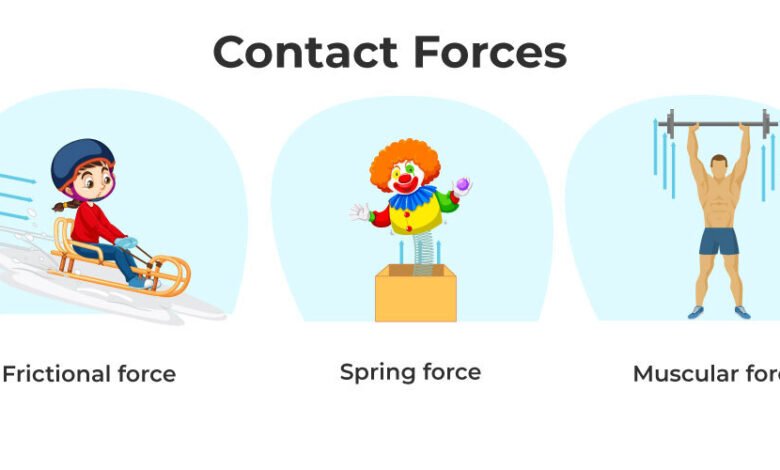
2. Frictional Force
Friction is one of the most familiar contact forces. It resists motion between two surfaces that are in contact. There are two primary types: static friction and kinetic friction.
Static friction prevents objects from starting to move. For example, when you try to push a heavy box, static friction resists your initial effort. Contact Force Definition Once the box starts moving, kinetic friction takes over and typically has a slightly lower magnitude.
Friction is caused by microscopic irregularities between surfaces. Even polished surfaces have tiny bumps that interlock when in contact.
Without friction, walking would be impossible. Tires would spin without gripping the road, and objects would slide endlessly once set in motion.
3. Tension Force
Tension occurs when a rope, string, or cable transmits force while being pulled tight. The force travels along the length of the object and acts equally throughout, assuming the rope has negligible mass.
For example, when you pull a bucket from a well using a rope, Contact Force Definition the rope exerts a tension force upward on the bucket.
Tension is always a pulling force; it never pushes. If a rope goes slack, the tension force becomes zero.
In engineering and construction, understanding tension is crucial for designing bridges and suspension systems.
4. Applied Force
An applied force is any force exerted directly by a person or object onto another object. When you push a cart, you are applying force through contact.
Applied forces can vary in direction and magnitude depending on the situation.
This force initiates motion and is often balanced by friction or other opposing forces.
Applied forces are central in understanding work and energy in physics.
5. Spring Force
Spring force is an elastic contact force that arises when a spring is compressed or stretched. It follows Hooke’s Law, which states that the force exerted by a spring is proportional to its displacement from its equilibrium position.
This force always acts in the opposite direction of displacement, attempting to restore the object to its original position.
Spring force explains how shock absorbers, mattresses, and mechanical systems function.
Contact Force vs Non-Contact Force
A clear understanding of the contact force definition requires comparing it to non-contact forces.
Non-contact forces act without physical contact. The most common example is gravitational force. The Earth pulls objects downward even though it is not physically touching them in the traditional sense. Similarly, magnetic force and electrostatic force act at a distance.
Contact forces, on the other hand, require direct interaction. Contact Force Definition If two objects are separated—even by a small gap—contact forces cannot act between them.
In practical problem-solving, distinguishing between these forces helps in drawing accurate free-body diagrams. Engineers, scientists, and students rely on this classification to calculate net forces and predict motion correctly.
Real-Life Examples of Contact Forces
Contact forces are everywhere in daily life. Contact Force Definition When you sit on a chair, the chair exerts a normal force upward to balance your weight. Without this force, you would fall through the chair.
Walking is another perfect example. Your foot pushes backward against the ground, and the ground pushes forward on your foot due to friction. This frictional contact force allows forward motion.
Driving a car also involves contact forces. The tires grip the road through friction. When brakes are applied, friction between brake pads and wheels slows the vehicle.
Even writing with a pen involves contact force. Contact Force Definition The pen tip exerts force on paper, and friction allows ink to transfer onto the surface.
Mathematical Representation of Contact Forces
In physics, contact forces are represented using vectors. They have both magnitude and direction.
For example, frictional force can be calculated using the formula:
F = μN
Where:
- F = frictional force
- μ = coefficient of friction
- N = normal force
Similarly, spring force follows Hooke’s Law:
F = -kx
Where:
- k = spring constant
- x = displacement
These formulas allow precise predictions in engineering and scientific applications.
Why Contact Force Is Important in Physics
Understanding the contact force definition is fundamental because most mechanical interactions involve contact forces.
In structural engineering, normal and tension forces determine whether buildings remain stable. In automotive design, friction and normal forces influence safety.
Biomechanics also relies on contact forces. Contact Force Definition The human body constantly experiences forces between bones, muscles, and surfaces.
Without understanding contact forces, it would be impossible to design machines, analyze motion, or ensure structural safety.
Common Misconceptions About Contact Forces
One common misconception is that contact forces are “solid” forces. In reality, they arise from electromagnetic interactions between atoms.
Another misunderstanding is that the normal force always equals weight. This is only true under specific conditions, such as when an object rests on a horizontal surface without acceleration.
Some students also believe friction always opposes motion. Contact Force Definition More accurately, friction opposes relative motion or the tendency of motion between surfaces.
Clarifying these misconceptions strengthens conceptual understanding.
Conclusion
The contact force definition describes a force that occurs when two objects are physically touching. These forces include normal force, friction, tension, applied force, and spring force. They arise from electromagnetic interactions at the atomic level and play a crucial role in nearly every physical interaction we experience.
From walking and sitting to engineering skyscrapers and launching vehicles, contact forces shape the mechanics of our world. Understanding them is not just about passing physics exams—it is about understanding how the physical universe operates.
When studied carefully, contact forces reveal the elegance of classical mechanics and the invisible interactions that make motion, stability, and structure possible.