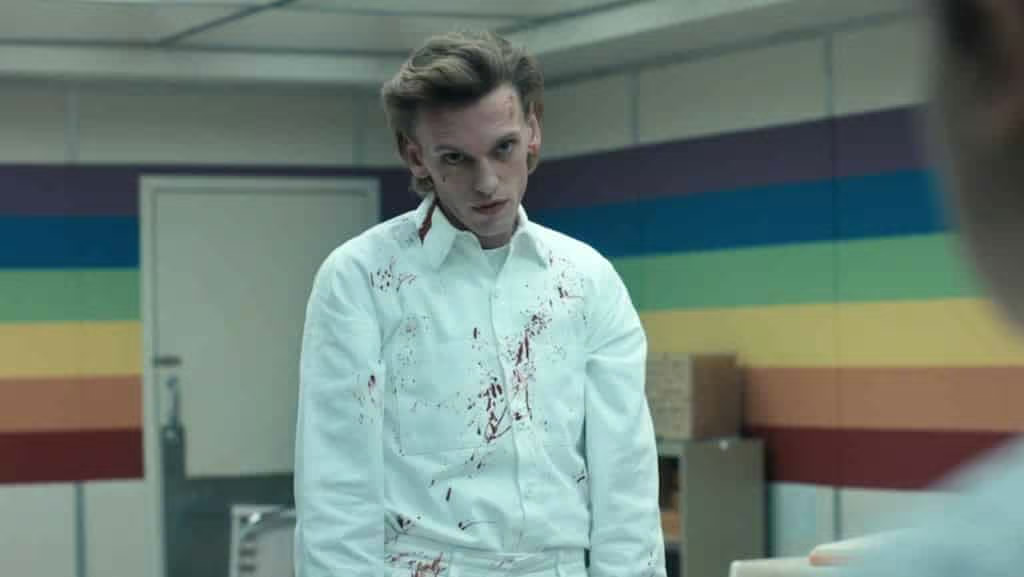
Introduction to Henry Creel
Henry Creel is one of the most complex and haunting characters introduced in Stranger Things, transforming the way viewers understand the mythology of the Upside Down. At first glance, Henry appears to be just another troubled child living in small-town America during the 1950s. However, as the story unfolds, it becomes clear that he is far more than that. Henry Creel is the foundation upon which many of the show’s horrors are built, serving as both a tragic victim and a terrifying antagonist.
What makes Henry Creel especially compelling is that he is not introduced as a monster in the traditional sense. Instead, he is presented as a sensitive, intelligent, and deeply isolated child who feels disconnected from humanity. His emotional distance and moral detachment set him apart early on, making his eventual transformation feel both inevitable and heartbreaking. The show takes its time revealing his past, allowing viewers to slowly piece together the truth behind his identity.
Henry’s story also marks a tonal shift in Stranger Things. While earlier seasons leaned heavily on adventure, nostalgia, and group dynamics, Henry Creel’s arc dives deeper into psychological horror and existential dread. His presence brings a darker, more philosophical layer to the series, raising questions about nature versus nurture, power, and the cost of alienation.
Ultimately, Henry Creel is not just another villain added to escalate the stakes. He is a character designed to reframe the entire narrative of Stranger Things. By understanding Henry, viewers gain insight into the origins of the Upside Down, the experiments at Hawkins Lab, and the thin line between humanity and monstrosity.
Henry Creel’s Early Life and Family Background
Henry Creel was born into what appeared to be a normal, middle-class American family. His parents, Victor and Virginia Creel, moved into a large house in Hawkins, Indiana, hoping for a fresh start after traumatic experiences during World War II. On the surface, the Creel family embodied the ideal post-war American household, complete with traditional values and a desire for stability.
However, from a young age, Henry demonstrated behavior that set him apart from other children. He showed little interest in socializing, displayed a disturbing lack of empathy, and often spoke about humanity in cold, analytical terms. Rather than seeing people as individuals with emotions, Henry viewed them as flawed creatures driven by lies, routines, and hypocrisy. This mindset isolated him further, reinforcing his belief that he was fundamentally different.
Henry’s relationship with his family was strained, even if not openly hostile at first. His mother, Virginia, sensed that something was deeply wrong and sought help, while his father remained largely unaware of Henry’s true nature. Henry perceived his parents’ attempts to control or “fix” him as betrayals, further fueling his resentment. This emotional disconnect played a crucial role in shaping his worldview.
The Creel house itself became a symbol of Henry’s growing darkness. As strange occurrences began to plague the home, it became clear that Henry was the source. Clocks malfunctioned, animals died, and the atmosphere grew increasingly oppressive. These events were not random; they were manifestations of Henry’s emerging psychic abilities, triggered by his growing contempt for the world around him.
The Awakening of Henry Creel’s Powers
Henry Creel’s powers did not emerge suddenly but rather developed gradually, intensifying as his emotional detachment deepened. He possessed extraordinary psychic abilities, including telekinesis, mind manipulation, and the capacity to perceive and exploit human trauma. Unlike other gifted children in the series, Henry’s powers seemed almost instinctual, as though they were an extension of his identity rather than something learned.
What sets Henry apart is his philosophical approach to power. He did not see his abilities as gifts or curses but as tools to reshape reality according to his beliefs. Henry viewed suffering as a means of exposing truth, believing that pain stripped away the illusions people used to hide their true selves. This disturbing ideology justified his actions in his own mind.
As Henry experimented with his powers, he began targeting his family. His mother, aware of his abilities, attempted to intervene, which Henry interpreted as an unforgivable act of control. In response, he used his powers to kill both his mother and sister, staging the deaths to appear supernatural and inexplicable. These murders marked the point of no return for Henry, solidifying his transformation from disturbed child to outright killer.
The physical toll of using his powers temporarily caused Henry to collapse, allowing his father to be falsely accused of the crimes. This detail adds another layer of tragedy to Henry’s story, as it shows how his actions destroyed his family not only physically but also emotionally and socially. Even at this early stage, Henry’s legacy was one of devastation and unanswered questions.
Henry Creel and Hawkins Lab
After the Creel family tragedy, Henry was discovered by Dr. Martin Brenner, the enigmatic scientist behind Hawkins Lab. Brenner recognized Henry’s potential and took him into the lab under the guise of protection and study. In reality, Henry became Brenner’s first and most important test subject, setting the blueprint for the lab’s future experiments.
At Hawkins Lab, Henry was stripped of his identity and autonomy. He was reduced to a subject, monitored and manipulated under strict conditions. Brenner attempted to control Henry’s powers using psychological conditioning and a suppressive device implanted in his neck. This device limited Henry’s abilities, effectively imprisoning him within his own mind.
Despite this, Henry remained intellectually superior to both Brenner and the other test subjects. He quickly understood the lab’s true purpose and saw through Brenner’s paternal facade. Henry recognized that the other children, including Eleven, were being groomed as weapons rather than nurtured as individuals. This realization fueled his hatred for the lab and strengthened his desire for escape.
Henry’s time at Hawkins Lab is crucial to understanding his later actions. The lab did not create his darkness, but it refined it. By treating Henry as an object rather than a person, Brenner reinforced Henry’s belief that humanity was inherently cruel and corrupt. This environment shaped Henry into a calculating, patient, and deeply vengeful figure.
Transformation into One and Vecna
Henry Creel’s identity evolved significantly during his time at Hawkins Lab. Known initially as “Number One,” he was the first successful psychic subject and the template for all others who followed. This numerical designation stripped away his humanity, reducing him to a rank rather than a name.
Henry eventually manipulated Eleven into removing his power-suppressing device, allowing him to unleash his full abilities. In a violent uprising, he massacred the lab staff and attempted to recruit Eleven to join him. When she refused, Henry attacked her, only to be overpowered and banished into the Upside Down.
This banishment marked Henry’s final transformation. In the hostile environment of the Upside Down, Henry’s body and mind were reshaped. The realm amplified his hatred and merged it with its alien ecosystem, turning him into Vecna. As Vecna, Henry became a god-like entity, capable of manipulating reality and preying on human trauma from afar.
Vecna represents the culmination of Henry Creel’s ideology. No longer bound by human limitations, he sought to destroy the world he despised. His attacks targeted vulnerable individuals, using their guilt and pain as gateways into their minds. This method reflects Henry’s lifelong belief that suffering reveals truth.
Despite his monstrous form, Vecna is still Henry Creel at his core. His motivations, beliefs, and resentment remain unchanged. This continuity makes him one of the most psychologically rich villains in modern television, as viewers can trace every action back to the wounded child he once was.
Psychological Depth and Symbolism of Henry Creel
Henry Creel is more than a villain; he is a symbol of alienation, unchecked power, and moral absolutism. His character explores what happens when intelligence and ability are divorced from empathy. Henry does not commit evil for pleasure alone but because he genuinely believes he is right.
Psychologically, Henry exhibits traits associated with extreme narcissism and antisocial behavior. He sees himself as superior, viewing others as insects trapped in meaningless routines. This worldview allows him to justify horrific acts without guilt. However, the show also hints that this mindset is a defense mechanism, shielding him from his own vulnerability.
Symbolically, Henry represents the dark side of human potential. His powers are not inherently evil, but his lack of connection to others warps their use. In this sense, Henry is a cautionary tale about what happens when society fails to nurture empathy alongside intelligence.
The recurring imagery associated with Henry, such as clocks and decay, reinforces his obsession with control and time. He despises the artificial structures humans impose on life, yet he seeks to impose his own rigid order. This contradiction highlights the hypocrisy at the heart of his philosophy.
Henry Creel’s Impact on the Stranger Things Narrative
Henry Creel fundamentally reshaped the Stranger Things universe. Before his introduction, the Upside Down was largely portrayed as an unknowable, external threat. Henry gave it a face, a voice, and a philosophy. Through him, the chaos of the Upside Down gained intention and direction.
His connection to Eleven added emotional weight to their conflict. Rather than a simple hero-versus-villain dynamic, their relationship reflects two possible outcomes of trauma and power. Where Eleven learns empathy and connection, Henry embraces isolation and domination.
Henry also ties together multiple narrative threads, from Hawkins Lab to the origins of psychic powers. His existence explains why the lab’s experiments were so dangerous and why the Upside Down feels intimately connected to human suffering. In this way, Henry serves as the narrative glue holding the series’ mythology together.
Perhaps most importantly, Henry Creel elevated the stakes of the show. His presence transformed Stranger Things from a story about survival into a story about moral choice. By confronting Henry, the characters are forced to confront what it means to remain human in the face of overwhelming darkness.
Conclusion:
Henry Creel stands as one of the most compelling characters in Stranger Things and modern television as a whole. His journey from isolated child to cosmic villain is tragic, disturbing, and deeply thought-provoking. Rather than relying on simple evil, his character challenges viewers to consider the roots of monstrosity.
What makes Henry truly memorable is that his story feels plausible within its supernatural framework. His descent is shaped by neglect, fear, and misuse of power rather than random cruelty. This realism makes his actions more unsettling and his presence more enduring.
As both Henry Creel and Vecna, he embodies the idea that the greatest threats often come from within. His character serves as a mirror, reflecting humanity’s capacity for both brilliance and destruction. In the end, Henry is not just a villain to be defeated but a warning to be understood.